

Knowledge gained by scholarship winners returns to Cameroon
 Cameroon
 Cameroon
They had never met until the Anesvad Foundation scholarship programme known as La Beca De Todas (in collaboration with the Mujeres por África Foundation) brought them to Spain in the spring of 2025. Now, having returned to their country, they are seeking new answers to the same question: what happens with NTDs once they have taken root in a community, and what needs to be done to eradicate them?


Doctors Ronie Fipa and Frédérique Seke arrived in Madrid as part of the same edition of the La Beca de Todas scholarship, which sponsors research placements at the Carlos III University for female African researchers working on global health and NTDs. It was there that, in conjunction with Isra Cruz and the rest of the team, they improved their knowledge to design a research protocol, trawling databases and converting years of experience in the field into something that could be submitted for scientific review. Neither of them arrived alone, and neither of them is alone now: they are both backed by a mentoring team in Madrid and a field team in Cameroon without which the research would be unable to make any progress.
They did not intend to remain in Europe, and they both said so, almost with the same words: they came to improve their skills and knowledge, not to change country. One year on, that decision has now become a routine: offices in Yaoundé, eastern rural communities, women trained as advocates, research that is half way to being published. Knowledge that never finds its way back cures no one, but when knowledge returns people are cured. Their commitment is to carry on fighting for a Cameroon free from NTDs, and ours is to continue supporting African researchers.
Knowledge there and back
In the rural communities of eastern Cameroon, water does not come out of a tap: it has to be fetched from the river, and the person doing the fetching is usually a woman. This daily journey is also a map of how some Neglected Tropical Skin Diseases (NTSD) affecting rural communities in Central Africa are spread. Frédérique Seke knows those routes by heart, and has walked them for months.
More a thousand kilometres away in Yaoundé, the country’s capital, Ronie Fipa carefully goes through the data files that she began extracting over a year ago, at Carlos III University in Madrid. Ronie arrived with a different question: what effect does the climate crisis – deforestation, warming, changes to land use – have on NTSDs? Her data-extraction stage has now ended.
All that remains now is for her to discuss the results with the team that has accompanied her and progress towards a scientific publication.
Frédérique: what happens after diagnosis
During her stay in Madrid, Doctor Frédérique Seke researched something that rarely makes the headlines: what happens to people affected by NTDs after diagnosis. Her review of the literature covered the disability, stigma, and exclusion that often follow the disease, and compared strategies already tested in Ethiopia and Senegal to see which ones could be adapted to Cameroon.
Cameroon could almost be a whole continent in one single country: over two hundred languages and a similar number of cultures, which makes any health strategy prepared within another context just a starting-point, never a ready-made approach. ‘The situation in Cameroon is not necessarily the same as that in Senegal or other African countries. We have to adapt to the situation in each community, otherwise the project stalls’, explains Doctor Seke. Women play a central role in that map, but not out of their own choice: they are the ones who walk to the river, work in the fields, and look after the children, and that means they are the ones most in contact with the vectors for the majority of NTSDs. She has already started testing them and is working on three fronts:
- Nomadic communities, which are especially exposed given their mobility.
- Communities in the east of the country, where illness is sometimes attributed to witchcraft and the person affected can end up being shunned by the rest of the community
- The health and administrative authorities, without the support of which no strategy can be truly implemented. ‘We can raise awareness among communities as much as we like, but if the strategies are not accepted at a State level, it will be difficult to implement them’, she emphasizes.
She does not pretend that this is anything more than just a start. ‘The system is still very new, almost embryonic’, she admits. This is why she has opted for a particular strategy: to train women from the communities themselves as sources of information, so that the message regarding prevention circulates from one house to the next. The aim is to support them with information that reduces the risk.
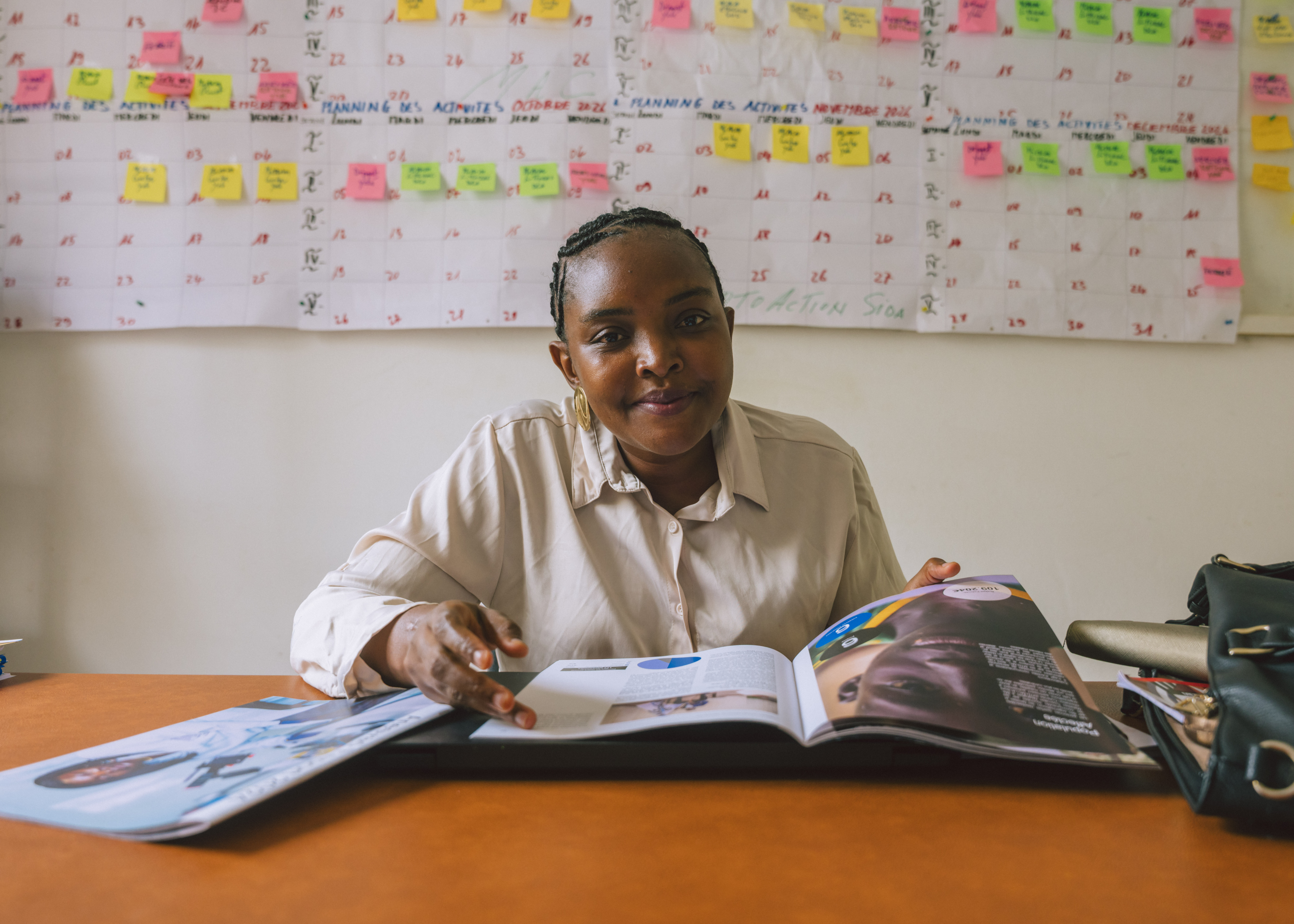
The question surrounding how the climate crisis affects NTDs was posed by Ronie by focussing on the Baka, an indigenous community from the south of Cameroon with whom she worked for over six years before receiving her scholarship. When she attempted to limit her review of the literature to just the Baka people, she barely found a dozen scientific articles on which to base her research.
Doctor Fipa and the Baka communities: researching were almost no one has looked
This absence, she says, is itself informative: it speaks of a community that almost no one pays attention to. According to her, there are those who see the Baka as inferior, and this view explains why so few organizations take an interest in their health: many people approach them because of their knowledge of the forest, not because of their wellbeing.
Along the way there was an unexpected pause: the birth of her daughter. Ronie feared that her pregnancy would cost her her scholarship, but it was not so. ‘I was pleasantly surprised that it had no impact. It was a scholarship aimed at women, and for the team that meant allowing for maternity rather than penalizing it.’
Today she takes up her work where she left off, determined to make it to publication, following which a Ph.D. to investigate the subject even further: the Baka people, climate change, and diseases that science has barely started to name.
