
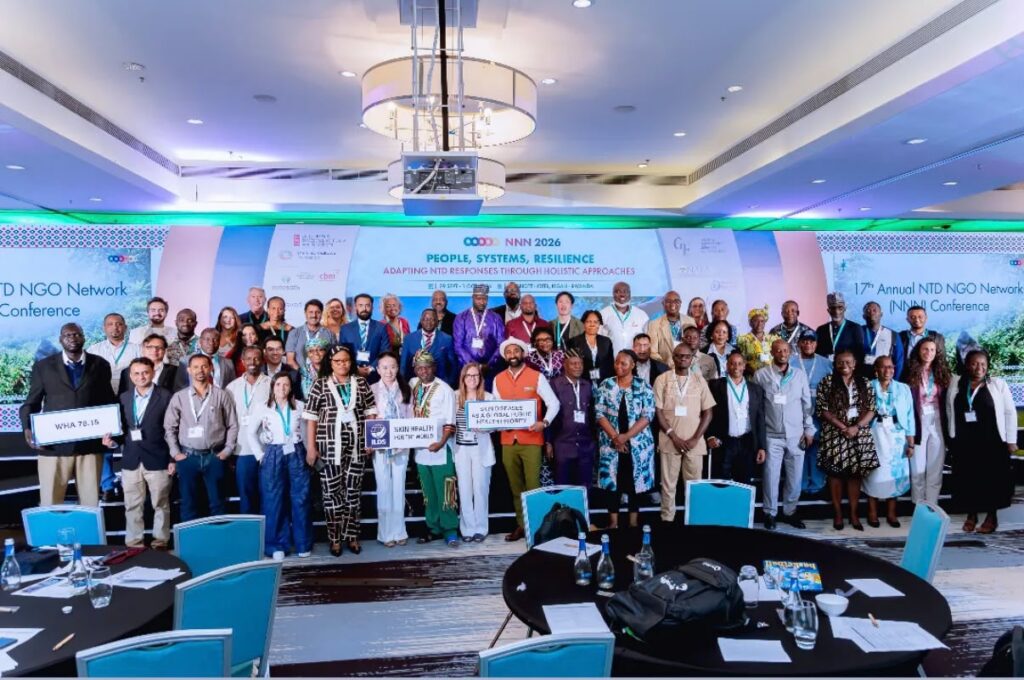
The opening plenary of the 17th Annual Conference of the NTD NGO Network (NNN), held in Kigali (Rwanda) from 29 September to 1 October 2026, placed people affected by neglected tropical diseases (NTDs) at the centre of the event. They did not come to illustrate the debate with their testimonies, but to lead it: they opened the conference, moderated the session and posed the questions that governments, the World Health Organization (WHO), funders and civil society had to answer.
NTDs affect more than a billion people, most of them in vulnerable communities, yet for decades decisions on programmes, research and funding have been made far from them. The Kigali plenary set out to reverse that logic in the most visible space of the conference.
Kigali 2026: a plenary built on lived experience
The conference theme —“People, Systems & Resilience: Adapting NTD Responses Through Holistic Approaches”— asked how to build comprehensive responses that put people at the core of health systems. The premise was clear: a holistic approach cannot be designed without the experience and judgement of those who live with these diseases. For that reason, the organising committee rejected giving them an isolated slot and chose to make their participation the backbone of the entire session.
The session was a dialogue between two panels. It opened with the Community Panel, made up of four people with lived experience of NTDs from Nepal, Ethiopia and Kenya —Dinesh Basnet, Yitagesu Habtu Aweke, Lucy Nkatha and Noelle Awa— and also moderated by affected people: Amar Timalsina (IDEA International) and Amaka Onyima-Esmai (Impact Group). Leading is not just about speaking up, but about steering the conversation.
It was followed by the Institutional Stakeholders Panel, with high-level representatives of governments, the WHO, funders and civil society, moderated by Inés Egino (Fundación Anesvad) and Anil Fastenau (GLRA). Amaka Onyima-Esmai also held a seat on this panel to bring the first panel’s questions directly into the institutional dialogue.
The format reversed the usual logic: it was not the affected people who responded to the institutional agenda, but the institutions who responded, with concrete commitments, to what the affected people raised. From access to care to stigma and mental health, one underlying idea emerged: participation is not enough; the power to decide what is planned and funded must be redistributed.
A journey that began in Kuala Lumpur
Kigali is the culmination of a three-year process in which Anesvad, with its allies and networks of affected people, has promoted within the NNN the shift from participation to leadership.
It all began with the closing plenary of the NNN 2024 Conference in Kuala Lumpur (Malaysia). It gave rise to an article in Nature Health, “Incorporating lived experience of neglected tropical diseases strengthens health research”, co-authored by affected people from Nigeria, Sierra Leone and Liberia —including Amaka Onyima-Esmai—, researchers and Fundación Anesvad. It challenges participation reduced to testimony and calls for co-design, capacity strengthening, leadership and fair compensation.
In 2025, the 16th Conference, in Kampala (Uganda), moved that voice from the closing to the opening with the panel “Nothing About Us Without Us”. The NNN has also built this commitment into its 2026–2030 Strategic Plan, whose regional consultation summed it up as: “We need genuine participation, not tokenism”. Kigali took the next step: a full plenary built around lived experience.
A sustained institutional commitment
For Anesvad, placing affected people at the centre is a direct consequence of its rights-based approach: they are not just recipients of health services, but rights-holders, bearers of knowledge and agents of change. That is why Anesvad was part of the organising committee and co-led, with GLRA, the strand on participation and leadership, with the aim of documenting the Kigali model so it can be replicated at future conferences.
The work continues. In Kigali, Anesvad took part in the workshop “From Principles to Practice”, together with organisations of affected people, youth networks and research centres, which will produce community tools to bring inclusion into operational research on NTDs. It is a concrete way of answering the call of the Nature Health article: that the principle of nothing about us without us should guide the future of the NTD response, from the field to funding bodies and political decision-making spaces.